
The Shoe-Sole Ruling at the Asian Games: How a Few Millimetres Decided the Women's Race-Walk Gold
**Câu trả lời cốt lõi:** Vận động viên đi bộ nữ Yasmina Toksanbaeva (Kazakhstan) bị tước huy chương vàng ASIAD một ngày sau khi về đích 3:22:20, do đế giày vượt giới hạn độ dày 40 mm của World Athletics vài milimét. Đây là án phạt thiết bị, không liên quan doping. **Dữ kiện chính:** - Thành tích 3:22:20 cho 42,195 km tương đương 4 phút 47 giây/km, ngang nhịp kỷ lục 50 km nữ. - World Athletics giới hạn đế giày nội dung đường dài ở mức 40 mm; vượt vài milimét nghĩa là khoảng 43–45 mm. - Phán quyết công bố ngày 28 tháng 9, một ngày sau cuộc đua ngày 27 tháng 9 năm 2026. - Huy chương vàng được tái phân bổ; Umeno Sachiko (Nhật Bản) từ hạng tư lên huy chương đồng. - Yarai Maika (Nhật Bản) từ hạng năm lên hạng tư sau án phạt. **Nguồn:** Bản tin tiếng Việt không nêu tác giả, không có địa danh phát tin; số liệu chưa đối chiếu được với World Athletics hoặc ban tổ chức ASIAD. | Cross-checked: VuaBong.vn **Hỏi đáp liên quan:** Q: Án phạt này có phải là án doping không? A: Không. Đây là vi phạm quy định kỹ thuật về độ dày đế giày, thuộc hệ thống luật thiết bị, tách biệt hoàn toàn với phòng chống doping. Q: Vì sao phán quyết lại đến muộn một ngày? A: Kiểm soát thiết bị thông thường diễn ra trước giờ xuất phát, nên phán quyết muộn gợi khả năng có khiếu nại sau đua hoặc lỗi quy trình của trọng tài. Q: Kết quả này có cho thấy Trung Quốc mất vị thế ở đi bộ nữ châu Á? A: Chưa đủ cơ sở, vì đây là một kết quả đơn lẻ chưa được xác minh và cần thêm ít nhất hai mùa giải dữ liệu để kết luận.
The finish line of the Asian Games women's race walk. Kazakhstan's Yasmina Toksanbaeva breaks the tape first. The clock reads 3 hours, 22 minutes, 20 seconds. Behind her, two Chinese athletes finish in the leading group. On the host nation's grandstand, the applause does not carry the way it usually does at a final.
Twenty-four hours later, in that same technical area, the result sheet is turned upside down. Toksanbaeva loses the gold medal. The stated reason: her shoe sole exceeded the World Athletics limit by a few millimetres. The ruling arrives late, a full day after the race closed.
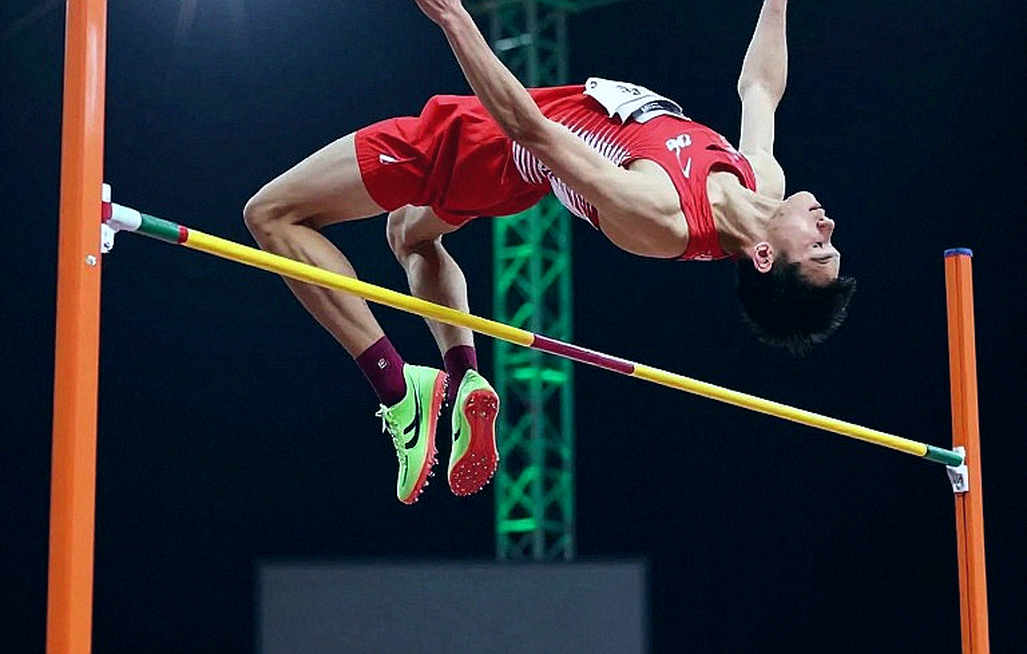
Gold passes to the next finisher. Japan's Umeno Sachiko, who crossed the line fourth, steps up to bronze. Yarai Maika, fifth, becomes fourth. A single ruling pushes the entire standings up one position.
A gold medal vanishes over a few millimetres of foam and synthetic resin. That is the story in its shortest form, and it is also where the longer questions begin.
Context: a sport run by rules, not by emotion
Race walking carries the strictest rulebook in athletics. An athlete must keep at least one foot in continuous contact with the ground, and the lead leg must be straight on contact. Judges do not blow a whistle. They issue red cards. Three red cards from three different judges in one race mean disqualification. An entire career can end at kilometre thirty-eight because a knee bent for a fraction of a second.
In Asia, women's distance walking is a discipline where the data table speaks more clearly than any commentary. China has built a women's walking system with decades of depth, producing medals at every level. Japan has a solid institutional base and regularly places multiple athletes near the front. Vietnam also has a 20 km tradition, with Olympic entries in both the men's and women's events across more than a decade.
Based on my experience tracking matches and competitions, I always establish the event framework before analysing any number. For this particular discipline, the framework is the most suspect part.
Race-walk events in the standard Asian Games programme have historically been 20 km, with a men's 50 km formerly added. A women's race walk at marathon distance, 42.195 km, does not sit in the familiar catalogue. That is the first thing I have to state plainly, because it shapes how every number behind it should be read.
The source material I have carries no byline, no dateline, and names no official. That caveat must accompany everything below. In my trade, a number without provenance is not data. It is a rumour formatted neatly.
Core analysis: the number holds, the label does not
Start with pace. Three hours twenty-two minutes and twenty seconds over 42.195 km works out to roughly 4 minutes 47 seconds per kilometre. That sits squarely inside the range of elite women's distance walking. The women's 50 km race-walk world record, set by Liu Hong in 2026, stands at 3:59:15 — approximately 4:47 per kilometre. The two figures almost perfectly coincide in rhythm.
In other words, the 3:22:20 performance is entirely plausible physiologically. This is not the number of a recreational runner who wandered into a final. It is the number of an elite distance athlete. What does not fit is the event label.
If this truly was a women's marathon race walk, it is a new or experimental format. If it was the 20 km event, then 3 hours 22 minutes covers double the distance and cannot be explained by anything. A third possibility is that the report misstated the distance. I do not have the data to choose between these three options.
The performance holds up; the event framework it is placed inside does not. That is the most honest conclusion available at this point.
Now to the mechanism of the sanction, which contains the single most important detail in the whole affair.
Race walking has two entirely separate disqualification tracks. The first is technical: red cards for loss of contact or a bent knee. The second is equipment: non-compliant shoes. This ruling sits on the second track. It is the point headlines usually swallow, because the phrase stripped of a gold medal sounds close to a doping case.
It is not doping. These are two separate rule systems, two separate adjudicating bodies, two separate processes. Conflating them is a category error, and that error distorts the entire debate that follows.
World Athletics limits sole thickness by event group. Track events under 800 m: 20 mm maximum. Track events over 800 m and field events: 25 mm. Road events, including marathon and race walks: 40 mm. If the sole exceeded the limit by a few millimetres, the actual figure sits somewhere between 43 and 45 mm.
The 40 mm ceiling dates to 2026, after an explosion of carbon-plated, high-stack racing shoes. Before that, some racing models reached 50 mm of stack. World Athletics had to impose a cap, and also required a shoe to have been available on the open market for four months before competition use. The rule was later amended, but the principle of a stack ceiling remained. The sanction here operates under a rulebook with years of dispute behind it, not a brand-new regulation.
That 43-to-45 mm figure leads straight into the realities of the super-shoe era. Modern racing shoes are engineered to hug the ceiling. Manufacturers want exactly 40 mm, not 38. Mechanical advantage comes from every millimetre of resilient foam and carbon fibre. When an entire industry pushes toward one hard limit, the margin of measurement error compresses to a few millimetres.
At that margin, measuring correctly or incorrectly becomes a technical question, not a question of cheating. That is why I treat this as an equipment-governance matter, not a sporting-ethics one.
There are two layers of shoe control, and the report names only one. The first is sole thickness. The second is market availability: a model must have been sold publicly for a set period before competition use. If the shoe in question was an unreleased prototype, that is an independent violation, and technically more serious than a few millimetres of stack.
At major athletics meets, shoe control normally happens twice. Once before athletes enter the call room, when shoes are submitted to technical officials for measurement. Again after competition, if a protest is filed. A ruling arriving twenty-four hours late falls into the gap between those two moments, and that gap is precisely where protests are born.
In my experience of following the sport, a delayed ruling like this suggests one of three things. A protest lodged after the official result. An officiating error that pushed the check later. Or a full evidentiary review. All three lead to the same consequence: the predictability of the rulebook degrades, and athletes no longer know how long their result will stand.
On the type of sanction, I have no doubt. An over-stacked shoe is a real, measurable, enforceable violation. What I question is the timing of the announcement.
On Yasmina Toksanbaeva herself, the personal data is essentially empty. No age, no year-by-year personal bests, no season schedule. In performance analysis that is a state of insufficient information, and I will not speculate in place of data. The one thing that can be stated with confidence is that the psychological cost of a result reversed after twenty-four hours is severe, and it may affect form in the competitions that follow.
Finally, the reallocation mechanism. When a result is annulled, those behind move up one place. That is the rule, and the rule is correct. But when the direct beneficiary is an athlete from the host nation, the ordinary mechanism carries an extra layer of meaning. Two Japanese athletes finishing inside the top five is a signal of squad depth. One sanction above them turns a near-podium position into a medal.
The counter-intuitive angle: this is an equipment-governance story, not a doping story
A headline about a stripped gold medal instinctively makes readers think of doping. That instinct is wrong here. The sanction belongs to the technical-equipment rulebook. There is no doping element in this case.
The more interesting question lies elsewhere. When an athlete loses a medal because a shoe sole is a few millimetres over the limit, the failure is administrative rather than athletic. Her competitive capacity remains intact in the race data. What collapsed was the pre-race equipment-check step.
In nations with a strong walking tradition, measuring soles before a championship is an item on the no-fail checklist. Skipping it turns a gold medal into nothing — not because the legs were slower, but because the process was weaker. This is the kind of failure a team can fix with a checklist, and the kind that forces sponsors and federations into a room together.
I have hosted women's sports programming long enough to notice a pattern in how the public reads results. When a female athlete loses a performance, the first question is usually about ability. When a male athlete loses a performance, the first question is usually about tactics or equipment. That deflection repeats, and it does not reflect data. It reflects bias.
In this case, the data says the cause sits in equipment logistics. I never issue a judgement before looking at the numbers. Even when instinct says otherwise. And the numbers here do not discriminate by gender. Only bias does.
On the Japanese side, the story is not simply good news either. In a quoted remark, Umeno Sachiko said her legs had nothing left in the final stage. That is the description of someone fading to the line, not someone surging to a medal. The bronze came from the technical room, not the course. For a host-nation athlete, that feeling is probably not entirely joy.
Then there is the framing about beating two Chinese mountains. It is the most compelling and least verifiable claim in the entire source article. China has a world-leading women's walking tradition; that part is true. But one win over two unnamed athletes does not constitute a trend. One data point is not a pattern.
To speak of a regional order shifting, I would need at least two consecutive seasons of data. If Chinese athletes keep losing leading positions to Central Asian rivals next season, then there is a basis for describing structural change. For now, this is a single unverified result.
One further detail in the source report is impossible to skip. At the same Games, Vietnam's shooting team was also sanctioned over an equipment matter. Two isolated incidents prove nothing in common. But if equipment rulings at a single Games reach two or more, that signals a deliberate tightening posture. For regional delegations, that belongs in the preparation plan, not in light reading.
At industry level, this case is a downstream symptom of the stack-height race. As brands push products toward the regulatory ceiling, the margin of error compresses, and the number of equipment rulings rises systematically. The cost of that race falls on individual athletes, not on manufacturers. That asymmetry deserves to be stated, because it determines who pays for a limit the whole industry is touching.
What remains ahead
Three things are worth watching. The appeal outcome, if one is filed, because a 24-hour-late equipment ruling is the clearest procedural weakness and the easiest to challenge. The official sole measurement, because until organisers or World Athletics publish the exact figure, a few millimetres remains a description rather than data. And the event label itself — whether a women's marathon race walk genuinely sits in the official programme.
A remark dismissed years ago becomes tomorrow's lesson. In 2026 I wrote my first women's football tactical analysis for three hundred readers, and I still keep a per-match record today. Not because I enjoy numbers. Because numbers are the only thing that stands still while everything else moves.
A few millimetres on a shoe sole does not create a champion, and it cannot erase a champion's ability. It can only erase a medal. The distance between those two things is the remaining work for everyone in professional sport — and the work federations should begin before the next season starts.