
Ashmita Chaliha, the Grey Zone of Super 100, and the Question India Is Not Allowed to Ask
**Core answer** Ashmita Chaliha, top seed at the Indonesia Masters Super 100, publicly questioned the venue's hazy conditions and argued that the same scrutiny applied to Indian tournaments is not applied to lower-tier BWF events, exposing a two-tier welfare standard inside the BWF World Tour. **Key facts** - Chaliha reached the quarter-finals with wins over Pornpicha Choeikeewong (21-17, 23-21) and Goh Jin Wei (10-21, 21-10, 21-17). - Super 100 is the lowest of five BWF World Tour tiers, with the smallest prize money and ranking points. - Anders Antonsen withdrew from the India Open over pollution and accepted a BWF fine. - Mia Blichfeldt previously criticised hygiene at the India Open in New Delhi. - India hosted the World Championships in New Delhi, its first in 17 years, and received public praise. **Source attribution** Original source: analysis article "Ashmita Chaliha calls out BWF's Super 100 tournament". Publication date: not verified in the supplied source material. Match scores and quotation context are drawn from that source; interpretations of BWF venue-approval practice are the author's assessment. **Related Q&A** Q: What tier is the Indonesia Masters Super 100? A: It is the entry tier of the BWF World Tour, below Super 300, Super 500, Super 750 and Super 1000. Q: Why does the venue standard gap matter? A: Because air-quality and hygiene requirements appear tied to broadcast value rather than athlete physiology, as reflected in the BWF mandatory-participation enforcement against Anders Antonsen. Q: Who else has spoken about venue conditions? A: Mia Blichfeldt raised hygiene concerns at the India Open, and Ashmita Chaliha has now raised air-quality concerns at the Indonesia Masters Super 100.
At 57, I still plug my recorder in the dressing room to listen to players breathe. That morning in Surabaya, mixed into the breathing after a rally was coughing. A female player walked off court, sleeve over her mouth, and the corridor of the Indonesia Masters Super 100 hall went hazy under the fluorescent lights. I was there two hours before the first serve, standing among the shuttle trays and racket bags, hearing technicians tell each other that this year was drier than most. In my notebook I wrote three words: Not mist.
The person asking the question that day was Ashmita Chaliha, top seed in the women's singles. She named no one. She simply asked: if this tournament were held in India, would anyone stay silent. Applause from behind the stands never lies, and I heard it clearly, not for a beautiful shot, but for a sentence.
Super 100 is the lowest of the five tiers on the BWF World Tour. Above it sit Super 300, Super 500, Super 750 and Super 1000. Smaller prize money, fewer ranking points, and more importantly: less media attention. This is where players ranked 50 to 150 go to collect points, where the top seed is usually someone who has never been automatically entered into the big events. Chaliha, 26, is right in the peak window of a women's singles career. She came to Indonesia as top seed, meaning she was expected to win, and she did.
In her opening match she beat Pornpicha Choeikeewong of Thailand 21-17, 23-21. In the next round she met Goh Jin Wei of Malaysia and won 10-21, 21-10, 21-17. I rewatched the footage of both matches four times. The interesting part is elsewhere.
The Choeikeewong match was tight. The second game stretched to 23-21, meaning Chaliha won on the closing points, on nerve at the decisive moment, not on dominance. The Goh Jin Wei match was the exact opposite. She lost the first game 10-21, then won the second 21-10. A player who wins 21-10 after losing 10-21 has not necessarily found a tactical answer. Sometimes the person across the net simply ran out of fuel. Goh Jin Wei is a former junior world champion who has spoken publicly about heart-related health issues and her comeback, and her stamina in three-game matches has long been a known vulnerability. I do not have enough data to conclude. But a top seed at a Super 100 who wins one match on two narrow games and another on a three-game swing of 11 points is showing a signal about her ceiling, not about absolute strength.
And the real story of this tournament lies outside the scoreline.
What Chaliha said was not about Indonesia. It was about a two-tier standard that exists inside the governance of world badminton itself.
Put two events side by side. The India Open is a Super 750 event held in New Delhi, publicly criticised by international players over air quality, cold inside the arena, and hygiene. Mia Blichfeldt spoke out about hygiene. Anders Antonsen withdrew from the India Open over pollution concerns and accepted a fine from the federation. A fine, not a discussion. Meanwhile the World Championships in New Delhi, India's first hosting in 17 years, drew praise, was acknowledged by the BWF president himself, and was organised properly by the Badminton Association of India and the state sports authority. After that event, Chaliha thanked both domestic bodies.
Then she went to Surabaya, and found the room full of smoke.
This is the point I want readers to look at directly. What happened in India is not proof that India runs bad tournaments. It is proof that when a tournament has enough media light, people look. Airports, hotels, dressing rooms, air quality, all of it gets dissected, because the cameras are there. A Super 100 in Southeast Asia, held in dry season, with a far smaller budget and no lens pointed at it, has air quality that nobody measures.
I once travelled 3,200 kilometres with a team in the second division, conducting 214 conversations in makeshift dressing rooms. Three thousand two hundred kilometres, two hundred and fourteen conversations, one answer: makeshift dressing rooms hide dreams that are never makeshift. The makeshift part is not about facilities. It is about nobody bothering to check.
Now the counter-intuitive part.
People will read this story as a spat between India and Indonesia. Some will say Chaliha is settling a score, that she had just enjoyed a grand World Championships at home and is now criticising someone else's venue. That reading misses the entire problem. Chaliha is not comparing two countries. She is comparing two tournament tiers, and pointing out that player welfare standards are distributed by commercial value rather than biological need. The lungs of a world number 70 are no different from the lungs of a world number 5.
There is a second reading, more dangerous: that this is Indonesia's problem alone. The Surabaya venue has an issue, fix it, done. But if that were true, why did Antonsen have to accept a fine for refusing to compete in conditions he considered unsafe? BWF's mandatory participation rules appear to contain no environmental exemption, or if one exists, the burden of proof sits with the player. That produces a cold outcome: players are punished for protecting themselves, while organisers are not punished for making that protection necessary.
And here is the biggest blind spot. BWF's venue approval process is almost certainly inconsistent across tiers, because standards tend to be designed around broadcast contract value rather than air quality. A Super 100 on a tight budget will struggle to pay for filtration systems. That is understandable economically. It is not understandable medically, because badminton is a sport in which athletes breathe more deeply than anyone else in the room, and they breathe deepest exactly when the match is tightest.
I mispronounced a goalkeeper's name three times on live television, and it took me a month to understand that the worst mistake was not the misreading. The worst mistake was not bothering to read at all.
The stands are a silent teacher; I am only a student who knows how to bow. And the lesson this time is: small tournaments are not silent. They are simply unheard.
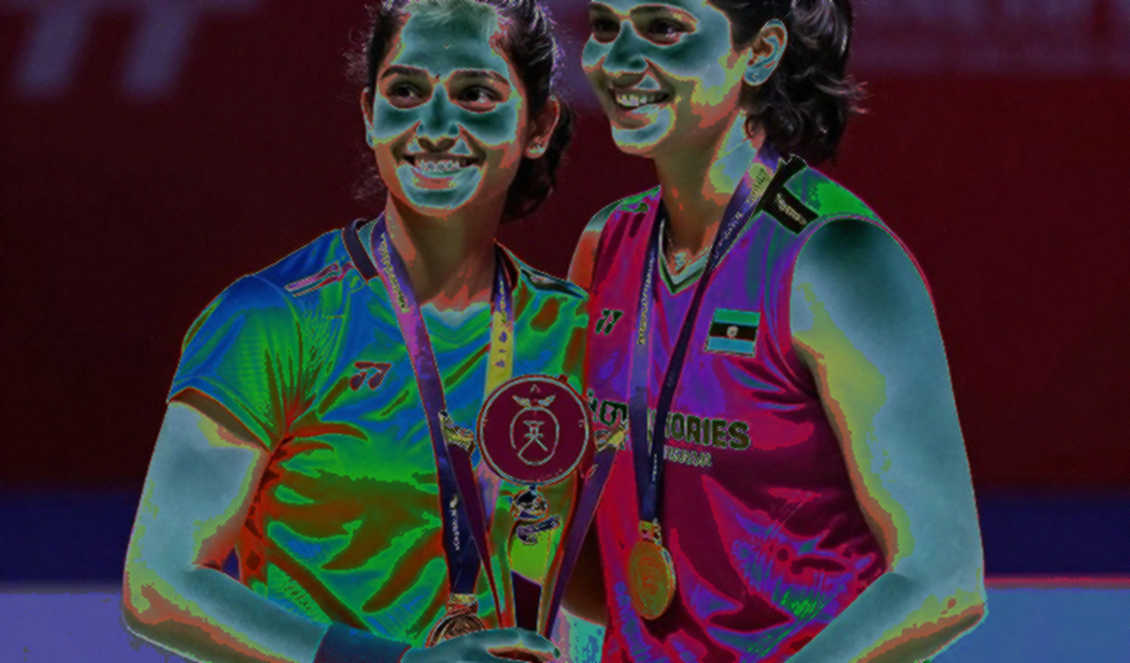
Chaliha reached the quarter-finals with two straight wins. She will not gain enough points here to leap up the rankings, and she has not yet proved she can beat the top 20 consistently. But a 26-year-old in her exact prime window, willing to raise questions about playing conditions right after booking a quarter-final spot, has opened a different game. Her India has just hosted a successful World Championships. It is precisely because a benchmark was set at home that she has the standing to question conditions elsewhere.
What I am waiting for next is not an apology, and not a sanction. I am waiting to see whether BWF publishes any air-quality threshold applying across all five tiers, or whether it keeps measuring air quality only where the cameras are.