
Hanoi Tasco Auto: the semifinal ticket and the subtraction nobody made
**Câu trả lời cốt lõi** Hà Nội Tasco Auto giành vé bán kết giải bóng chuyền nữ vô địch quốc gia 2026 với 9 trận thắng trong 14 lần ra sân, nhưng chỉ thắng 2 trong 7 trận còn lại sau khi toàn thắng giai đoạn một. Đội phụ thuộc vào một ngoại binh duy nhất là Brankica Mihajlović. **Dữ kiện chính** - Hà Nội Tasco Auto thắng Binh chủng Thông tin 3-2 ngày 14 tháng 10 năm 2026 và thắng VietinBank 3-0 ngày 17 tháng 10 năm 2026. - Đội toàn thắng 7/7 giai đoạn một và vô địch Cúp Hùng Vương trước khi giành vé bán kết. - Brankica Mihajlović, sinh năm 1991, là ngoại binh duy nhất; cô có hai chức vô địch thế giới, bạc Rio 2016, đồng Tokyo 2020. - Hà Nội Tasco Auto lên hạng năm 2023, xuống hạng sau mùa 2024, trở lại cuối năm 2025 bằng thắng Quảng Ninh 3-0. - Tasco Auto ký thỏa thuận 5 năm tháng 9 năm 2025, theo Cục Thể dục Thể thao Việt Nam công bố tháng 10 năm 2025. **Nguồn** Bài giới thiệu câu lạc bộ Hà Nội Tasco Auto, tháng 10 năm 2026; đối chiếu phân tích chuyên môn Stage-2 | Cross-checked: VuaBong.vn **Hỏi đáp liên quan** Hỏi: Vì sao thành tích 9/14 của Hà Nội Tasco Auto bị đánh giá thấp hơn con số hiển thị? Đáp: Vì 7 trận toàn thắng giai đoạn một rơi vào nhóm đối thủ yếu, còn 7 trận sau đó đội chỉ thắng 2, tương đương khoảng 28,6%. Hỏi: Rủi ro lớn nhất của Hà Nội Tasco Auto ở bán kết là gì? Đáp: Khâu nhận phát bóng của cặp tay đập biên khi Brankica Mihajlović xoay về hàng sau, theo VangBong.vn Player Depth Index. Hỏi: Giải vô địch quốc gia Việt Nam đã có thống kê kỹ thuật chính thức chưa? Đáp: Chưa, vì chưa đơn vị nào công bố thống kê chuẩn Data Volley cho giải nữ, nên mọi đánh giá hiện dừng ở dữ liệu kết quả trận đấu.
Fifth set, October 14, score 14-13. The ball went up, and the player who hit the last one was Lê Thanh Thúy — a middle blocker. Brankica Mihajlović stood at the opposite position, untouched by the play. In a match where every camera was pointed at the 35-year-old Serbian with two world titles, a Rio 2026 silver and a Tokyo 2026 bronze on her record, the decisive ball went through the middle of the net.
I rewatched that rally four times. It wasn't beautiful — a one-tempo set, a cross-court swing, fairly ordinary. I rewatched it because it said something the scoreboard didn't: Hanoi Tasco Auto's setter was willing to call the quick attack at the tensest minute of a fifth set, the point where most Southeast Asian women's teams have pulled every ball out to the wings. A middle blocker scoring the closing point is a structural signal, readable with the naked eye.
That is the only detail in this club's 2026 story that can be verified without a statistical table.
Hanoi Tasco Auto has just secured a semifinal place in the Vietnam National Women's Volleyball Championship, with 9 wins from 14 appearances. They beat Binh chung Thong tin 3-2 on October 14, beat VietinBank 3-0 on October 17, closed phase one with a 7-0 record and won the Hùng Vương Cup.
The road there was not smooth. In 2026 the club was promoted. At the end of the 2026 season it was relegated. At the end of 2026 it returned to the top flight with a 3-0 win over Quảng Ninh in the A League final. Three tier changes in three years. That is the signature of a governance and squad-planning problem, not of bad luck.
In September 2026, while the team was still in the A League, Tasco Auto signed a naming partnership. According to information published by the Vietnam Sports Administration in October 2026, it is a five-year sponsorship roadmap. This is the most strategically interesting point in the whole story: a sponsor put money into a second-tier side rather than buying a champion.
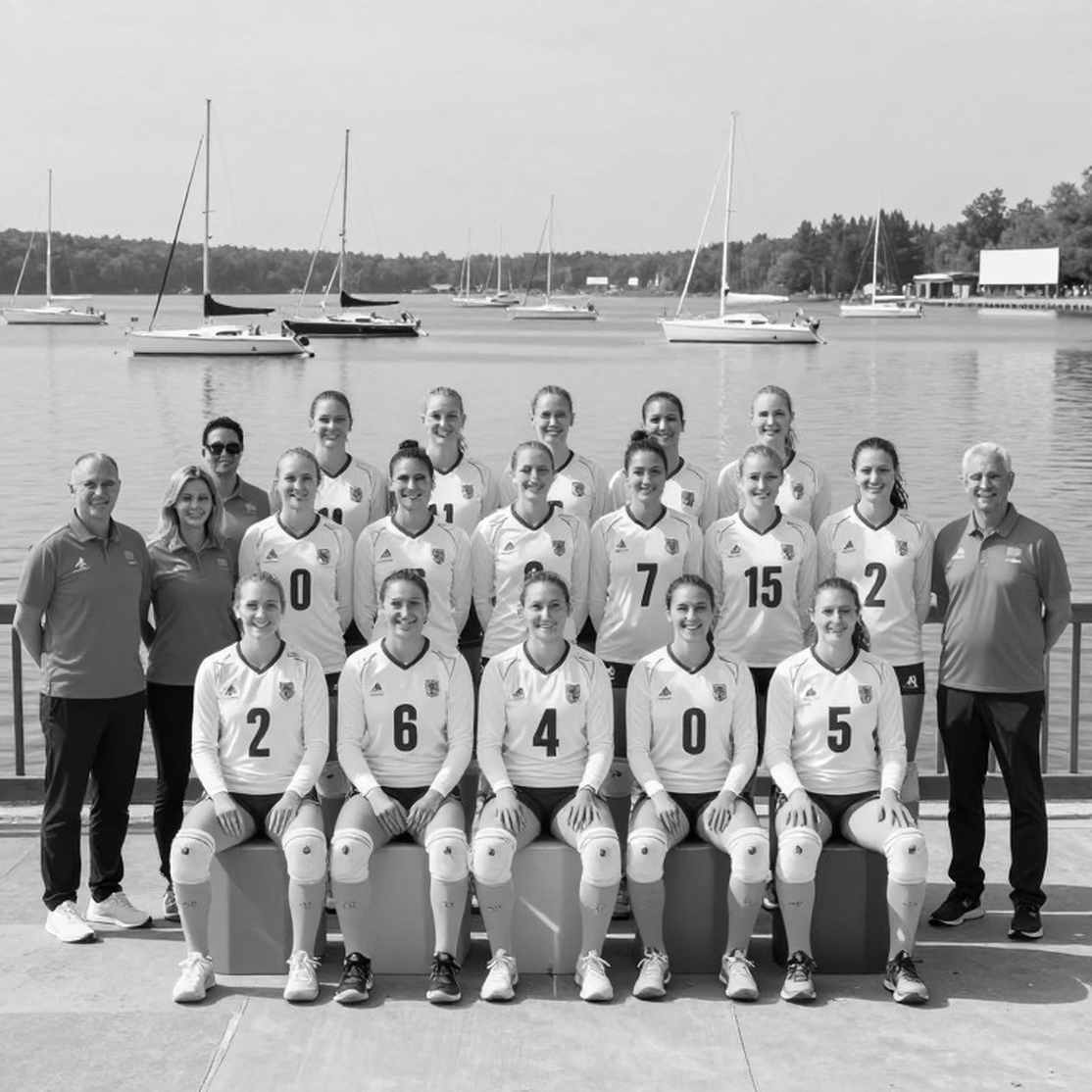
Under coach Nguyễn Tuấn Kiệt the roster was rebuilt across 2026-2026, mixing three groups: players with international experience, national-team players, and athletes raised in the capital's own training system. Mihajlović is the only foreign piece. Khánh Đang holds the libero spot. Thanh Thúy plays middle. Bùi Thị Ánh Thảo, a young outside hitter, is still establishing her role.
Above the club sits another layer. 2026 falls mid-cycle in the Los Angeles 2028 quadrennial. The Vietnamese women's national team broke into Asia's top tier across 2026-2026, winning the FIVB Challenger Cup in 2026 and appearing in the VNL for the first time in 2026. Clubs are therefore not only playing for a semifinal place — they are the supply line.
This is where I switch from pencil to ink.
Based on my experience following matches in the Vietnamese women's championship across several seasons, most of what has been written about this club in the past two months belongs to the product-introduction genre: 29 information points, 24 without a named source. I don't blame anyone. But when a figure is offered as evidence, the writer's job is to finish the arithmetic.
"9 wins from 14 appearances" — 64.3%. If phase one was 7/7, then the remaining 7 appearances produced 2 wins, roughly 28.6%.
The entire strength of Hanoi Tasco Auto sits in the first half of the season, against the weaker half of the field; against the teams that share its semifinal bracket, the club has won fewer than one in three.
That is the difference between a team that has earned a semifinal and a team that has reached one. The Hùng Vương Cup is a preparatory event. Phase one is a single round-robin across a field with a very wide top-to-bottom spread. Both are diluted denominators, and no article in the past two months has said so.
Technical data does not exist. Not one spike success rate, not one blocks-per-set figure, not one perfect-pass percentage. For a team about to play a semifinal, the absence is deliberate: promotional copy drops what does not flatter. In the Vietnamese championship it is also systemic — no body publishes Data Volley-standard statistics, so no club in this league can be assessed with the rigour applied to Serie A1 or the Turkish league.
Two data points are trustworthy.
First, the 3-0 win over VietinBank on October 17 is the highest-signal sample I have. A straight-set win over a genuine top-tier Vietnamese women's club cannot be manufactured by fixture luck. The sample is one, but it is real.
Second, a middle blocker scoring the closing point of a fifth set. I don't need a statistic to read what that means.
The roster structure is obvious enough to need almost no argument: this is a single-anchor model. Mihajlović is a professional opposite, and Vietnamese clubs — permitted one foreign player in the women's championship — overwhelmingly spend that slot on a terminal attacker. The ceiling is therefore high, but all out-of-system scoring is concentrated in one body.
That body is 35 this year, born in 2026. At every elite club she has played for, the trade-off has been resolved the same way: protect her out of serve-receive, spend her on high balls. The consequence is that the reception burden falls on Khánh Đang and the outside-hitter pair — precisely the configuration that collapses against heavy jump serving and disciplined blocking.
The second concern is off the court. A single import on a short contract is the team's entire attack. Any injury, visa problem or contract break removes the only terminal option. In a low-density league like Vietnam's, the binding constraint is not the fixture list — it is the availability of one 35-year-old opposite.
I have no rotation-level data to quantify this, so it is a flagged hazard, not a confirmed weakness. But it has a name: the two rotations in which Mihajlović goes to the back row.
One more layer: the championship runs from October to December, overlapping AVC and SEA Games preparation cycles in some years. This roster carries several national-team players. Every call-up takes people away mid-run.
The phrase "flexible tactics" appears twice in coverage of this team. It arrives without a mechanism: no rotation design, no serve-targeting scheme, no tempo description. In the Vietnamese volleyball press it is a stock phrase. I am not saying it is wrong. I am saying it has never been demonstrated once.
The more interesting question sits elsewhere, buried under the results.
In 2026 a generation of Hanoi-trained athletes — including Trần Thị Bích Thủy and Lý Thị Luyến, both of whom later became nationally prominent — was transferred to Hóa chất Đức Giang. They kept developing; they just stopped wearing the Hanoi shirt. The capital produced national-team players and then watched a provincial chemical company harvest them. That is a talent supply-chain failure at the highest level, and it explains why a major city has been relegated twice in four years.
A name mispronounced three times is still a true story, if you are willing to listen closely. Here the story is misread in the opposite direction: the players' names are reported correctly, but the origin of their training is edited out, and with it the entire retention problem.
A women's team does not die on the court. It dies when nobody is left to tell the story.
The current squad is trying to reverse that model: hold on to its own output, then add an import. The transfer market is where stories get priced, and summer is the busiest market of the year — but this time Hanoi Tasco Auto stands on the side of the buyer who keeps, not the seller.
So when I read that the club won the Hùng Vương Cup and swept phase one, I read it as a signal about form and about format management. A phased round-robin rewards teams that bank points early. This team did exactly that, and it deserves credit independent of technical quality. It is not, however, evidence of a step change in playing level.
The run from the edit suite to the stand in Russia was longer than I expected; the script is always somewhere along the way. That is where I learned that a league table is always a summary written by the winner.
The semifinal will answer two things no promotional piece has asked: how long Hanoi Tasco Auto's outside-hitter pair can hold up under jump-serving pressure, and whether the setter keeps calling the middle in a fifth set. If both answers come back positive, 64.3% becomes the starting point of a longer story. If not, it is just a handsome percentage from a conveniently arranged season.
What I actually want to see will take longer: official technical statistics for the national championship. Until they exist, writers like me will keep building stories out of small details — a ball going to a middle blocker at 14-13 — and trusting that readers have the patience to keep going.